Reverse Osmosis Water Treatment – How RO Filtration Works

Reverse osmosis water treatment: Key takeaways
- Reverse osmosis water treatment forces feedwater through a semi-permeable RO membrane, removing well over 90% of ionic contamination, most organic compounds and effectively all particulates.
- RO operates at roughly 4–15 bar (60–220 psi); typically 15–30% of the feedwater becomes purified permeate, while the rest exits as concentrate.
- RO does not remove dissolved gases, and rejection of non-ionic molecules below about 100 Dalton can be low — purity depends on feedwater and operating conditions.
- RO is the first purification stage for many sensitive laboratory applications; combined with deionization (DI) or EDI it produces reverse osmosis DI water (RO/DI water).
What is Reverse Osmosis (RO)?
Reverse osmosis water treatment is a membrane filtration process that pushes water through a semi-permeable RO membrane to separate dissolved salts, organics and particulates from purified water.
RO is a filtration technique that uses the particular properties of RO membranes to prevent the passage of a wide range of impurities to a high degree, greatly purifying the feedwater.
What does Reverse Osmosis remove from water?
RO membranes prevent the passage of contaminants in water that are more than about 0.1nm in effective diameter. Typically they remove well over 90% of ionic contamination, most organic compounds and effectively all particulates. RO removal of non-ionic contaminants with molecular weights (MWs) of <100 Dalton can be low. It increases at higher MWs and, in theory, molecules with MWs >300 Dalton, including particles, colloids, microorganisms and large biologically-active molecules, will be rejected completely. Dissolved gases are not removed.
How does Reverse Osmosis water filtration work?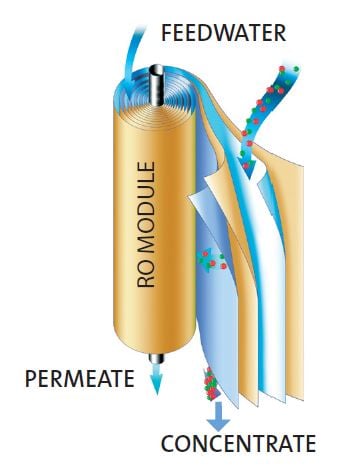
In short: feedwater is forced under pressure across an RO membrane — clean water (permeate) passes through, while concentrated impurities are flushed away as the waste (concentrate) stream.
During RO, feed-water is pumped past the input side of an RO membrane under pressure (typically 4-15 bar, 60-220 psi) in cross-flow fashion. Typically 15-30% of feed-water passes through the membrane as permeate and the rest remains on the inlet side and exits as the concentrate stream that contains most of the salts, organics and essentially all particulates.
This membrane filtration reverse osmosis process depends on durable thin-film membranes and proper pre-treatment, as detailed below.
RO membranes are typically thin film polyamide and are stable over a wide pH range, however, they can be damaged by oxidizing agents such as chlorine, and fouled by organics or colloids, so pre-treatment is usually required to protect the membrane. The membranes require relatively high pressures to overcome back-pressure; to maximise surface area membranes are usually wound in a series of layers in a spiral as shown in the diagram. If the water recovery rate is too high raised concentrations of sparingly soluble hardness salts will lead to membrane blockage.
What are the benefits of Reverse Osmosis?
The great advantage of RO is the very wide range of impurities that it removes. As well as reducing the load on subsequent purification technologies it also protects them from contamination and fouling by large organic molecules, for example, humic and fulvic acids, and completely rejects micro-organisms and viruses present in feed water.
Because RO removes such a broad range of contaminants, it is the ideal first stage ahead of deionization: pairing RO with DI or EDI produces reverse osmosis DI water (RO/DI water) for the most demanding analytical and life-science applications.
How does ELGA LabWater use Reverse Osmosis?
RO is a key technology in the ELGA PURELAB range. Long lasting, high efficiency membranes are used throughout. ELGA PURELAB stand-alone or pre-treatment units contain RO. Polishers such as those in the Chorus 1 range are designed to ideally be fed with water that has been treated via RO.
In a full PURELAB system, RO is combined with ion exchange and EDI to deliver consistent DI RO water (RO/DI water) at the purity grade each laboratory application requires.


